Showing posts with label fiction elements. Show all posts

Friday, June 27, 2014

On Genre Inbreeding and the Lineage of Bertbert

All right, y'all, bear with me.  This is a post about the dangers and temptations of wearing ruts in your favorite section of the bookstore, but it is also a five-star extended analogy (plus an excuse to wax nostalgic about one of my favorite things ever.)

There is a game called The Neverhood, released far back in the mists of time (1996, to be exact.)  It's a claymation point-and-click adventure, in which our hero, Klaymen, wakes up alone in an empty world, and must solve puzzles to discover the truth of this abandoned paradise.  It is simply fabulous.


Anyway, one building in the Neverhood contains the Hall of Records.  Its walls tell the story of Quater, a supreme being, who fashioned seven sons, and gave each the power of creation.

The second of Quater's seven sons was Bertbert.
Empowered by Quater to create, Bertbert, believing that he himself was Quater, begat another Bertbert.

This second Bertbert begat Bredbad, a weak attempt at a Bertbert; but with a speech impediment.

...

Bredbad, having no point of reference but himself, begat Bridabrack the Literal.

Who begat Bickback. Bickback was thin for his age and his peers mocked him for the purple and green skin splotches that covered his body. Once a large crowd of descendants of Bertbert had formed, poor Bickback was made to sit in the back.

...

Bickback lived a happy life; he wed Phyllis, a demure little lady, also from the back of the crowd.

He begat Mak Mok which means "low is high."

Mak Mok begat Mak Mak.

Who begat Mak Mak.

Who begat Mak Mak.

Who begat Mak Mak, who fashioned a two-sided being which included both genders, male and female, one on either side. It was a colossal being named Mammur who was very proud indeed.

The begetting continues unabated.

Klee, having become ruler of all the land of Fep, was compelled by his people to change his name to Fay Nee, which means, "Most of which still do not agree."

Fay Nee begat Fay Nee.

Who begat Wah Nee.

Who begat Acker, who looked nothing like his father, Wah Nee, but nonetheless, managed to create Ehp.

...

Ehp's own creation came out looking like a pile of something badly burned, so he named it, "Uh Uh."

Uh Uh was not alive, so it could not beget anything.
Thus ends the lineage of Bertbert.
(Bust photo from The Neverhood Wiki)
So maybe you can already tell where I'm going with this.  About how (for example) The Lord of the Rings begets Dungeons & Dragons, which begets the Dragonlance Chronicles and Forgotten Realms, which begets R.A. Salvatore's Dark Elf Trilogy, which feeds in to fantasy MMOs like EverQuest and Neverwinter Nights, and before you know it, everybody's in on the action. 

And then, of course, there's the glut.  Millions of people grow up reading about / watching / playing as elves and dwarves and short plucky people, so hundreds of thousands of people write about them, and thousands of people with really pretty good stories end up getting rejected over and over again because Legendary Swords Are So Done, and Sorry, We're Full Up on Chosen Ones, and NO ELVES EVER.

It's not that NOBODY can spin that yarn anymore - but like tyrannosaurs stomping through the jungle eating over-ambitious tiny mammals, the big-name established apex predators of the genre are now dominating it so thoroughly that it becomes really hard for any new voice to grow to comparable size.  Effectively, the genre conventions become an albatross around your neck: you may succeed, but if you do, it will be IN SPITE OF your graceful Aryan elves and axe-wielding beardtacular dwarves, and not because of them.

Because if we learned anything from Dragon's Crown,
it's that you really can have too much of a good thing.
(Photo from IGN)

And that is a shame.  Because it means that we are probably missing out on a lot of pretty kickass stories.

I'm not totally sure how we get around that.  But my eye is still drawn to that phrase from gen-three Bertbert up above: having no point of reference but himself.  If all we ever read is fantasy, how can we bring anything new to the fantasy genre?  If all we ever read is romance, or lit-fic, or thrillers, how can we contribute anything but more taut abs, dysfunctional Appalachian childhoods, and troubled badasses running from checkered pasts, respectively?

Anyway, I don't mean to sit here and act like I've got it all figured out or anything.  But when we sit down to write fiction, I do think it's worth considering where the book will fall in your chosen genre's genealogy - you know, what its "begats" are, and how many distinct ancestors it really has.  Because having a diverse gene pool is probably at least as important for a thriving literary culture as it is for Tasmanian Devils not going extinct from contagious face-cancer.  And for fictional clay dynasties, natch.


Companions are chosen for you by the Management.  You will normally meet them for the first time at the outset of the Tour.  They are picked from among the following: BARD, FEMALE MERCENARY, GAY MAGE, IMPERIOUS FEMALE, LARGE MAN, SERIOUS SOLDIER, SLENDER YOUTH, SMALL MAN,  TALENTED GIRL, TEENAGE BOY, UNPLEASANT STRANGER, and WISE OLD STRANGER.

Sunday, September 29, 2013

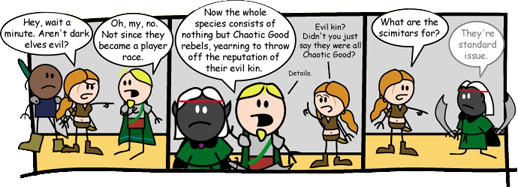
All I Really Need to Know About Fiction, I Learned From "The Order of the Stick"

So today is the tenth anniversary of a webcomic called The Order of the Stick.

It was in the news last year when its creator, Rich Burlew, launched a Kickstarter campaign to reprint OotS books that went on to raise $1.25 million - yeah, that's million with an M - through crowdfunding alone.

That is as it should be.

It's easy for me to say that, because it's easily my favorite comic (web- or otherwise), and one of my favorite stories.   Certainly the only one for which I've woken in the middle of the night and checked for updates.

This is the webcomic wallpaper equivalent of "Ode on a Grecian Urn":
forever wilt ye be oblivious to the monsters, and they be one second away from stomping you flat.
But if I were to distill my unrelenting enthusiasm down into something coherent and halfway meaningful, I would say this:

1.  I love what Burlew's success says about us as an audience.  You know, it's easy to get bitter and cynical when a terrible movie makes eleventy-billion dollars, or when your favorite show gets cancelled after like, an episode, or when Twilight of the Vampire Spankings outsells the Bible.  It is so nice to be reminded (and Burlew is certainly not the first to do it) that there is still room in the world for intricate, thoughtful, entertaining, first-rate fiction, and that we don't have to wait for it to be handed to us from the exalted offices of New York and L.A. - that we-the-people can hoist our favorite fictioneers up on our shoulders and reward them with success all on our own. 

2.  I love what Burlew's success says about him as a creator.  Yeah, he made a million bucks off of Kickstarter - but before that, he was working for nine years on his own initiative.  And maybe that is easier to do when you're posting weekly pages of a webcomic - getting feedback on the spot from your readership - than it is when you are slaving away for months at a time on a novel or some other massive Frankenproject, feeling trapped in the sweaty dark pit of your lightless word-hole as you sink into despair and wonder if you'll ever finish, or whether anyone will care when you do.  But I have no doubt in my mind that he started with the right question - not "how can I make a million bucks and be famous?" (because a webcomic is NOBODY'S answer to that one), but "how can I tell a really fun awesomecool story?"

3.  I love what The Order of the Stick has taught me as a storyteller.  I'm not kidding.  If you look on the ingredients label for One Night in Sixes, you will find that it is at least 18% OotS.  Which might sound weird, given that one is a fantasy Western steeped in blood and history, and the other is a comic about DnD stick figures.  But man, those little sticks have seeped into my porous wrinkled head-sponge like nothing else.  There in two brightly-colored dimensions is proof positive -

--that you can tell a story bigger than any single character's narrative arc

--that a complex story with multiple main characters is not doomed to bog down or burn out

--that "funny" and "epic" are not mutually exclusive

--that epic fantasy can be momentous and significant without disappearing up its own asshole

--that worldbuilding, setup, and backstory can and should be just as entertaining as the rest of the story

--that blood and sex and eye-candy are optional, but characters worth caring about are not

--that good and evil are not fixed, static alignments - no matter what the Player's Handbook says.

I could go on, but if there's one other thing that The Order of the Stick is good for, it's reminding me that a head full of story is only worth as much as your ability to sit down and keep knocking out the pages. 

Anyway: happy birthday, little sticks.  Thank you for lighting up my life.  And good luck with those velociraptors.

--But if we don't have noses, how do I smell?
--Like cheetos, you diminutive wastrel.

Thursday, September 19, 2013

Midnight Brain Drippings: the Good, the Bad, and the Angry

Not going to lie, you guys: I am seriously overclocked these days.  Really want to do another GrammatiCats post, but it may be a bit before I get that far.

But I was rebellious and hedonistic enough to go to workshop last night, and to the traditional IHOP foray following, and we ended up having an especially savory conversation.  It was a swirling syrup-drizzled vortex of big expensive TV shows and giant sprawling book series and the frustrations of aspiring writerdom at large. Here for posterity and my own future reference:

On Big Fat Fiction:

1.  There seems to be a trend nowadays toward deeply flawed / unlikeable characters (Mad Men*, Game of Thrones, et al.)  "Idiots being mean to each other."

*I've only seen 1 1/2 seasons of Mad Men, and don't know how true this is.  But I remember being deeply impressed at how the writers managed to craft a suspenseful, dramatic, multi-layered story when so many traditional staples of TV drama - drugs, murder, violence, explosions, et al - have been taken off the table.

2.  A steady diet of "good guy vs. bad guy" stories can get tiresome, especially when you already know that the good guy is going to win.

3.  Many writers seem to have shaken out of the above mold by writing "bad guy vs. bad guy" stories - or less simplistically, an ensemble cast of morally gray characters at odds with each other.  Strange that "good guy vs. good guy" seems not to be terribly much in fashion.  (Premier hallmark example: The Wire. This is my favorite kind of story, and what I've tried to accomplish with Sixes.)

4.  A Song of Ice and Fire blew my mind when I first read it, because it was such a departure from the Big Fat Fantasy I'd read up until then - giant multi-thousand-page epic-quest monomyths where everybody's an archetype and Joseph Campbell spoiled the ending 60 years ago.  But see #2.

5.  But amazing groundbreaking fiction stops being amazing when it goes on long enough to establish its own constant trends.  If there's a likable character in ASoIaF on the verge of accomplishing something valuable and important, you can lay down your last dollar on it ending in a horrific botch.  It's still plenty interesting to watch the dominoes fall, but there's no longer the suspense of wondering whether they will or not.

And from a separate branch of the conversation,

On the Frustrations of Writing:

6.  So many aspiring writers getting frustrated when they've been so careful to play by the rules, and yet get nowhere.  (Passing similar to what I've heard when guys' well-intentioned efforts to meet women are continually rebuffed.  "I did everything you said you wanted - why don't you like me?")  Very hard to avoid this feeling when the people telling you "no" won't tell you straight what you're doing wrong so you can fix it.

7.  #6 above makes rich ground for unscrupulous people to sell ridiculous prescriptions to the desperate and frustrated.  Even well-meaning folks can unwittingly become bad prophets this way.

8.  Possibly part of the problem is writers asking the wrong question - wondering "how can I get published and make hella money and have my book in all the stores" instead of "how can I become a super bad-ass awesome writer?"  Too much emphasis on the nouns and adjectives - book deal, famous, published, author, signings - instead of on the verb, the activity of writing, as a worthy end in itself.

9.  But in fairness, it's hard not to get one's righteous rageface on when Twilight and 50 Shades sell beaucoup millions while violating all or most of the rules of good fiction that we keep raking each other over the coals about.  Readers can catapult a book to fame on the strength of "cuz I liked it."  Writers have no such luxury.

And separately from everything else,

10. "Red Hulk" is a stupid name for a comic book character.  Full stop.


Anyway, back soon with something more coherent.  For similar, better-curated pearls of wisdom from my posse, visit DFWWW in the meantime.  Our milkshake brings ALL the word-addicts to the yard.

This looks like a job for Bipolar Bear!  But I just can't seem to get out of bed...

Sunday, September 8, 2013

DC Comics and the Case of the Deathless Media Franchise

It's been a big week for comic book drama.

The greatest tidal wave of Internet outrage has come from DC's new contest - and while asking artists to draw Harley Quinn naked and suicidal is definitely not the worst item on the company's social sensitivity rap sheet, it's really not helping.  (Next up: Batman sobbing helplessly as he masturbates to a Leave It to Beaver rerun!  Ha-HAAaaaaa!)

The second wave of the PR shit-nami has come as DC vetoed Batwoman's marriage to her long-term partner - while being careful to articulate that they are not objecting to lesbian superhero marriage, but superhero marriage across the board.  (And yes, dear reader: even Aquaman.)

Which brings us, rather retroactively, to A Lee Martinez's latest post.  He calls it Continuing Drama vs. The Dreaded Third Act, and opens with this:
One of the reason I enjoy writing standalone novels is that it allows me to tell stories that have a beginning, middle, and an end.  Series fiction is, almost universally, stuck in the second act by its very nature.
ACT ONE: Peter Parker gets bit by a radioactive spider, gains superpowers, learns a lesson on personal responsibility.
ACT TWO: Spider-Man struggles to fight crime and redeem himself in his own eyes and the eyes of the city he defends.
ACT THREE: Spider-Man learns to balance his obligations as both a superhero and an ordinary man, gets married, has some kids, stops being such a sadsack.
Yes, it’s that Act Three that’s the problem.  It NEVER happens.  It was never intended to happen.  Spider-Man is stuck in that second act, and he will never actually get out of it.
(I highly recommend clicking over to read the whole thing - it's a humdinger of a thesis.)

For all the publicity it's garnering at the moment, DC's weird, regressive Peter-Panning just shines a brighter spotlight on an issue that's been endemic to franchise fiction pretty much since the get-go: namely, that you've set up a system that pits your brand against your story - and the brand wins every time.

Would it be interesting to see Spider-Man get his Act Three?  It certainly was back when they called it The Incredibles.

But if we actually let Spider-Man grow and change as a character, we'd eventually run out of Spider-Man stories to tell - and Happily Ever After does not sell comic books, action figures, or kids' underoos.

So we have to keep the machine going.  Superman and James Bond and Dr. Who have been so calcified by time and money that their adventures will never, ever end - we'll just keep swapping out their puppeteers as needed.  And the more closely a supporting character orbits that fixed heroic center of their universe, the less they will be allowed to change.  (Killing off Squid-Boy?  No problem.  But Jean Grey just can't stay dead.)

That is the part that sticks in my craw.  When you know going into the story that the good guy can't achieve final victory OR die trying - that the Earth will not get blown up, or stay blown up if it does - that any substantial growth the hero has to do already happened back in his origin story - it feels like... well, kind of like how my good buddy Ike probably feels when he bumps up against the aquarium wall.  You know, like the story should be moving you forward into consequences, costs, changes, fallout -  but there's something artificial holding you back.  (Or in the case of mainstream comics' chronic retconjuration, letting you move forward and then teleporting you back.)

It's like some kind of invisible force field...!
And to be clear: I don't mean to dog on deathless franchises, or snipe at the people who enjoy them.  But I think it's interesting that we advocates of progressive nerd-dom get so vexed about these things - about DC's misogyny and militant super-bachelorhood, and the eternally white male Doctor, and all that mess I ranted about in Skyfall - when for the whole life of the franchise, we've basically been paying its creators not to change.


Not that we shouldn't ask for our favorite series to become more progressive, more inclusive.

Just that if they seem to be terminally stuck in the 1960s, it's because that's where they came from... and if they seem to be hell-bent on staying there, we might ought to quit spending so much energy ranting and begging and shaming them to move forward, and start putting our love and money into series that already have.

I hear Image Comics is lovely this time of year.

He writes not of love but of lust, of defeats in which nobody loses anything of value, of victories without hope and, worst of all, without pity or compassion.

Saturday, February 2, 2013

The Agony, the Ecstasy, and the Drudgery

Two events have dominated my personal cosmos this week.

1. My fellow Red Sofa colleague (Sofette?) Jamie Wyman Reddy signed a contract with Covet Books, an imprint world in the Entangled Publishing star system, to publish her debut novel, Technical Difficulties. (That is a lot of modifying clauses, which gives you a sense of the excitement for this occasion!)

2. Without going into too much detail, one of my nearest and dearest has been diagnosed with an illness of the It's Pretty Much Downhill From Here varietal. This hasn't shattered my world, but has left a sizable crater, and prompted a modest remains-of-my-innocence extinction event.

(Y'all don't be reaching for the sympathy cards or anything - this is not cancer or Alzheimer's or anything else to make a Lifetime movie out of, and it's far less of a game-ender than an eventual game-changer.  There is still plenty of joy in Mudville.)  

Here's what those two things have in common.

Take a second and check out Jamie's epic publishing odyssey (a five-minute masterpiece of wit, gifs, and the universal energy source known as feels).  With entomological precision, she neatly pins down those multiple bouts of protracted uncertainty and fraught waiting-periods like so many unlovely butterflies.

And from what I can tell, that's about what medical anomalies tend to net you too.  You start with a lump or a cough or a tic, and wait for it to go away.  When it doesn't, you call the doc and wait for an appointment.  Then you go in and get a once-over and a referral.  Wait for another appointment.  Go to the specialist, get an appointment for a culture or a biopsy or what-not.  Wait for that.  Go in, get it done, and wait yet again - by this time, on the most agonizing rusted-out tenterhooks imaginable - to receive the verdict.

And are we done now?  Not hardly!  All of this was just to get the diagnosis, or to sign the contract.  There's all manner of waiting-times yet to come - to hear back from the publisher about revisions and royalties and release dates, to find out what and how much InsuriCare will spring for and whether you might could get accepted into a local research program - and here's the big thing:

You have to keep interrupting this massively important narrative arc to get your own stupid regular stuff done.

You know what I mean.  Jamie can be absolutely vibrating with tension as she waits to get that phone call, but she's still gotta collect her kidling and fix dinner for the fam.  I can stare down the abyss of mortality, but at some point I have to leave off long enough to go teach class.

This is what is so damn sexy about fiction.  Fiction is the ultimate fast-forward button.  It's the big-ass tub of nuts you can choff without having to stop and crack shells.  It's a magical road trip where your bladder's always empty and the gas tank is always full.  When it's time to be happy or sad or anxious or whatever, you can wallow in that one feeling exclusively - marinate in it! - because the fictioneer has thoughtfully excised all the irrelevant distracting parts that would take you out of the mood.

So there you have it.  Fiction is the luxury of singular focus, the pornography of time and theme.  That is probably not news to anyone, but I have to say, I have a new appreciation for all that artificial streamlining.  The alternative out here in the real world is vexing as hell!

You know the old saying, "Time flies when you're having fun?"  This is the dire half-dragon version of that.

Thursday, January 10, 2013

Being Malton Milquetoast

Well, as of yesterday, it's official: One Night in Sixes is out on submission.  I would say something here about taking up a position at the punch bowl and waiting to be asked to dance, but that is exactly the wrong kind of metaphor.  Better to say that I've already got my dream date, we are already cutting one hell of a rug, and we have no plans to pause until the the lights come up and the judges are ready with their scorecards.

In the meantime, here is another thought that's been a few months in the making.  (Yes, I suck at topical timeliness.)  Let's talk about these guys:

Just in case you didn't catch them in theaters, they're the Sugar Rush racers from Wreck-It Ralph.  And I bet you can spot their pattern even if you didn't see the movie.  Shoot, you could probably make up your own glucose-fueled NASCAR cherub, if you wanted to.

DAT TIE.

As it happens, that is exactly what Ronald MacKinnon did.  Meet Malton Milquetoast, mild-mannered soda jerk and high-octane milkshake stuntman.

(We may pause here for a moment of virtual cheek-pinching, yes.)

So what?

Well, in the words of LRC, the triple-initial-wielding author of Springhole.net:

I really think writers should create universes that are friendlier to fan characters... Any fiction that has a small and non-negotiable number of Chosen Ones or Special People is hostile to fan characters by nature. Be a good sport and share your toys - write universes that easily accomodate fan characters and make the rules and mechanics clear.

(Incidentally, Wreck-It Ralph does a stellar job on this front.  Halfway through the movie, we have absorbed all the relevant rules: how the video game worlds connect, which characters can cross from one to another, what could happen if they do.  I could write a competent canon-faithful sequel right now, with no more guide than the original movie.)

"Well," you might very-reasonably say, "I don't especially care to do that.  They're my toys, it's my creation, and I believe you'll find that copyright law supports my decision not to willingly open my universe's door to every amateur-hour writer and artist who wants to take a free ride on my hard work."

You would be entirely justified in saying that.

However, it's also true that competition for followers, readers, listeners, and buyers is fiercer than it's ever been.  And no matter how prolific a content-creator you are, it ALWAYS takes longer to create said content than it does to consume it.  The book I spent three years writing can be read in a few hours.  A song that took a month to produce plays out in three and a half minutes.  Shoot, even a meme takes longer to write, assemble, save, and upload than it does to "Like" and "Share". 

So I think a good question for ALL content creators to ask themselves is, "what am I giving my fans to do while they wait for my next work?" 

Because if you look at the biggest, most mega-successful series of recent years, a tremendous number of them - Harry Potter, The Hunger Games, Avatar: The Last Airbender, My Little Pony, Adventure Time, Star Wars, and others- are so intricate and explorable in their mythology that they seem almost custom-designed to encourage future fan-created ponies and wizards and Jedi and benders of every imaginable stripe.  (As a matter of fact, you may reliably find Mr. MacKinnon working undercover as Equestria's resident advice columnist and self-appointed field medic, Ask Charlie Foxtrot.)

Lumbering laboriously to the point, then: you CAN craft your world however you want.  You CAN hold it up as a perfect, untouchable work, to be admired and critiqued from behind museum glass.  But if you design it a little differently, build in some few extra features ahead of the curtain rising, and then have the courage to toss the whole thing out into the mosh pit, I think it'd be enormously satisfying to watch your creation go crowd-surfing as you set to work on the next one.

I am looking forward to saying that with authority, though.

I'm gonna wreck it!

Tuesday, December 11, 2012

10 Things I Learned From Watching "Skyfall"

Well, I tried to cut this for spoilers, but I can't get the dang cut to work.  So let me do this the old fashioned way and say

Hey

There's some spoilers here.

So probably you should see the movie first.

With that said...

10 Things I Learned From Watching "Skyfall"

1. If a female agent has a hard time driving big cars and assassinating bad guys, she'd probably be happier as a secretary.

2. Corollary to #1: if you have to fire a woman for gross incompetence, make sure you replace her with a man ASAP. 

3. Flicking your cigarette butt into a coworker's drink is a fun way to show how you respect her as a colleague and an equal.

4. Surprising a rape survivor in her shower is a great way to get laid.

5. Using a woman for target practice is *definitely* a waste of good Scotch.

6. Homosexuals are bad people who will molest you at the first opportunity. 

7. Corollary to #6: any good guys who happen to be homosexual will have the decency to keep that to themselves.

8. Nerds can type on their little keyboards all they want, but if you need to crack the unbreakable computer code, let a real man take a look at it.

9. Corollary to #8: you probably shouldn't have let Poindexter play with it in the first place - he's only going to make a bigger mess.

10. It's okay to be a physically and mentally unfit alcoholic pillhead who botches jobs and gets people killed, as long as you get the bad guy.

Look, I know it's supposed to be a fun spy movie, not a monumental step forward in the quest for diversity and social progress.  And I get that this is the James Bond franchise, not the MI6 Justice Friends.  He's the hero, so he's supposed to do most of the cool stuff and have all the deep and interesting flaws.

But that's exactly the problem.  If James Bond is a flawed hero, then I'm supposed to ride along in his head and root for him while he makes terrible decisions and treats women like garbage.  If he's a fundamentally broken anti-hero and we're *not* meant to identify with him, then this is basically a story about a guy who is rewarded for being a terrific asshole, mostly by virtue of being the least incompetent person in the movie.

I dunno.  This thing is currently sitting on $260 million and 92% on the Tomatometer, so it's clearly given a lot of people some solid entertainment.  But I'll say this much: anyone who still wants to lament America's descent into a dark age of political correctness needs to clam up and catch another matinee.

What do you say about a man like that?

Monday, November 12, 2012

Some Assembly Preferred

So here in the US, the electoral afterbirth has been mopped up, the tear-stained editorials have mostly dried, and the relevant political parties are changing back into their sweatpants and wife-beaters for another year.

Whew.

I tell you what flipped my lid, though: the morning after the election, I logged on to Facebook and saw a comment from one of my other-side-of-the-fence friends that stopped me dead in my Inter-tracks.

 "Fwoah," thought I. "THAT'S what this election was about for you? I didn't know we were voting on that!"

And I don't care to get too much into the partisan particulars just here, but suffice to say that for one of us, the Rebel Alliance has blown up the Death Star, and for the other, Luke Skywalker has just been murdered.

I don't expect that kind of reality-schism is news to anyone: there's something in the human brain that hardwires us to feel like a valiant, oppressed underdog no matter which side of what issue we happen to be on. But what gets me is that it is *almost impossible* for us to take in even the scantest handful of facts and NOT make a story out of them.

That lady in the Ford Dreadnought that just cut you off? Clearly a clueless ditzy gas-hog soccer mom.

The hurricane that ate New York? Obviously the result of global warming / the coming apocalypse / a completely random natural phenomenon / Ororo Munroe on bath salts.

I'm just saying.

These things don't exist in a vacuum. Our story-making brains are CONSTANTLY sifting through all the thousands of Erector-Set facts spread out around us, picking up the ones that fit our current project, and sidelining the rest.

Wait, you're telling me Governor Goodguy did THAT? Who reported it? Well, THEY'll say anything.

Hey, did you hear this rumor about Senator Sonofabitch? I knew he was a dirtbag!

And all of the above, my fellow fictioneers, is why I will always love stories that don't come pre-assembled. Sure, it's fun to pull a shiny new Transformers movie out of the box and start smashing up Decepticons. Sometimes it's nice to let good guys wear white hats and bad guys twirl their mustaches and damsels lap-dance on the train tracks.

But I got a special place in my heart for the writers who make building the toy part of its fun. "Okay, where does Shylock go? Yeah, he's kind of a dick, but if I make him the villain, then what kind of jerk-ass hero is Antonio?" "Well, and what do we do with the Ministry of Magic? Is it just an incompetent bureaucracy, or is it actually responsible for You-Know-Who?" "And while we're at it, I'm just gonna put Harry Dresden in his own special little box waaaaay over here."

Anyway: good luck with the building, y'all, and a special shout-out to all my fellow NaNo'ers who haven't yet started hallucinating word-count meters in your Wild Turkey writing binges.  Don't despair - we'll get there!

That was black magic, and it was easy to use. Easy and fun. Like Legos.

Tuesday, September 25, 2012

Wedging Open the Wardrobe Door

You know, there's no shortage of Magical World stories out there. The ones where some schlubby Earth-person (usually of the teen varietal) is drawn into another world and has to pass the test, save the world, win the day before they can go back to their own life in Anywhere, USA. It's a fantasy-genre classic.

But there's a handful of yarns out there where the magic door stays open - or less literally, the magical/fantastic elements become a semi-permanent fixture of the hero's life. So then Dapper McTeen has to defeat the Dark Lord while simultaneously cramming for an algebra test.  (See: Animorphs, Sailor Moon, Buffy, Spider-Man, etc.) 

Those kinds of stories maybe don't fit so neatly into Joseph Campbell's narrative designs, but I've always had a soft spot for them.  Because that's what real life is.  No dying alien ever takes the time to write a note saying "Please excuse Hal Jordan from his mission tomorrow; he has to go save the galaxy."  That sucker just drops a load in your lap and croaks. 

And for most of us, if the giant purple wormhole in the sky is not *actively* spewing out Geiger-esque alien abominations, it is really, really tempting to just leave the spandex in the dryer and try like the dickens to get caught up on e-mails before you have to start fixing dinner.  This is why so many of us are rattling around with unfinished manuscripts and lingering guilt.  It's not because you're a grown-up and the wardrobe door to Narnia has closed.  It's because it's all blocked up with dirty clothes and boxes of unsorted tax documents and that one cooler you're afraid to open because you're pretty sure you never cleaned out the leftovers from last year's 4th of July shindig. 

On second thought, maybe I'll let Mr. Tumnus come find me.

This is pretty much where I've been at the last couple of weeks.  Missed writer's workshop on Wednesday because I had to go give an exam out in Alfred J. Shitkicker County.  Missed FenCon this weekend - 8 hours of driving/delivering on Friday, 14 hours of helping a friend move house on Saturday, 10 hours of teaching and tutoring on Sunday.  Good chance of missing workshop again tomorrow, because my company is comprised of helpless assholes.  It's exhausting and depressing and miserable and I want to go play cowboys-and-frog-monsters so bad I can taste it.  (It tastes kinda like pickled boot-leather, if you were wondering.)  More than anything, I really, really, REALLY want to finish the first draft of my book proposal before my in-laws hit town on the 13th - to hit Save, turn 30, and enjoy a week of unrelenting Texo-Scottish anarchy with a clear conscience and an empty inbox.

So wish me luck, fellow Fantasians, and the best of same with your own wardrobes, wormholes, star-gates, and time machines.  There are wondrous worlds on the other side - we just gotta get there!

Life isn't all fricaseed frogs and eel pie.

Friday, August 24, 2012

When the Cavalry Ain't Coming

You know what's BS about Pandora's Box? 

You (or at least I) grew up hearing about how she opened the box and let every imaginable evil out into the world - war and death and disease and inner-ear zits and all the rest - but then she closes the box and hey, it's okay, because HOPE is still inside.

Well hold on there, Sparky: if Hope were still in the box, we wouldn't have it out here in the real world, right?

I've always preferred the scholars who translate that word, elpis, as Expectation.  Without Expectation - without actually KNOWING how we're going to die or what-all's going to happen to us in the meantime - we have a chance to go forward optimistically, to live the Eric Idle creed and Always Look on the Bright Side of Life... because hell, you never know; today might really be better than yesterday!

Which is why, when done well, historical fiction can REALLY put your emotional knickers in a twist.

Take this book here: Between Shades of Gray.  (And no, I don't know what Ruta Sepetys thinks about E.L. James, but I would LOVE to see a cage-match for title rights.)  It's about a young Lithuanian girl named Lina, who's taken from her home by Soviet police in the summer of 1941, and condemned to a brutal Siberian labor camp, along with thousands of other political prisoners.  At first glance, it's one of these Very Important Books that get big applause on the YA circuit, because it highlights and humanizes an especially horrendous period in history in a way that's accessible to young folks today.

So there I am, reading along with my 9th-grade tutoring student as the atrocities mount and the body count rises, and I start feeling my old Anne-Frank instincts kicking in.  "Come on, Lina - just hang in there 'til '45, and then G.I. Joe and the Allies are gonna come romping and stomping through there and everything'll be... wait, hold on."

I actually had to go look it up, because - come on, how much did YOU learn about Lithuanian history?

And I tell you what, friends, that one Google search got me right in the breadbox.  No stars and stripes for these poor souls: Lithuania and the other Baltic states were swallowed whole, annexed by the USSR (you remember, those other guys who were so helpful in blowing up the Death Star that we went halfsies on Germany), and the pathetic fraction of those millions of stolen citizens who survived internment weren't pardoned until 1954.   The Baltic states didn't reappear on the world map until *1991*. 

Which means that in all probability, Lina wouldn't live to see her country resurrected.  (No spoilers for the book here - its scope doesn't extend nearly that far.)  She and the millions whose experience she represents would have lived the remainder of their lives as second-class citizens, slowly smothered to death by age and unrelenting censorship. 

But okay, that's maybe not news: if you one-upped me and stayed awake in fourth-period history class, you knew all that already.  You would crack open this same book already knowing how the broader strokes of the story will play out, even if you don't know what will happen to the individual characters.  (There's that Expectation thing again: for the Baltic prisoners as a whole, it's already flown the coop - we know how things will turn out for them - but hey, Lina and her family might still make it somehow!  Turn them pages faster, damn you!)

Instead, what I want to point out is how, when we see tragedy like this in historical fiction, it's so often played in a "damn, just missed it" context.  All Quiet on the Western Front, Grave of the Fireflies, The Plague  - hell, even Titanic sucks you in with this timeless trope, that better days are just around the corner for anyone who can make it that far.

But I think we can get just as much moral mileage, if not more, out of stories on the other side of optimism: when the author (of the novel or the history book, either one) has made it clear that there's not going to be any reinforcements or armistice or vaccine coming - that with the course of history already set, any hope to be had must come from the characters themselves.

Anyway, that's my deep thought for the week, hope you enjoyed it.  And now to bed, cuz tomorrow is going to be exceptionally long on Hope and short on Expectation.

They took me in my nightgown.

Friday, June 22, 2012

Adding the Egg

Gentle readers, let me tell you a story.

It's a story about cake.

In the latter half of the 1950's, sales of commercial cake mix flatlined.  Which was a real stumper for Duncan Hines et al: they'd enjoyed barnstorming sales numbers in the ten years since the first high-quality, shelf-stable mixes went on the national market. 

During this time, cake mixes had been marketed overwhelmingly for convenience.  Here's an example from 1955:
"So simple you CAN'T go wrong."

So General Mills dispatched a fellow named Ernest Dichter to get to the root of the problem.  As Laura Shapiro reports in her excellent book, he came to this conclusion:

After interviewing women and exploring the emotions that surrounded cakes and baking, Dichter reported that the very simplicity of mixes - just add water and stir - made women feel self-indulgent for using them. There wasn't enough work involved. In order to enjoy the emotional rewards of presenting a homemade cake, they had to be persuaded that they had really baked it, and such an illusion was impossible to maintain if they did virtually nothing.

The solution?  Give the baker more to do.  In microcosm, this could be as simple as adding an egg to the mix, transforming the process from menial dump-and-stir to 'real' baking.  But in the bigger picture, this idea took off in the form of cake decorating.  Marketing emphasis shifted to what the baker would do once the cake came out of the oven: a whole explosion of creative and often labor-intensive cake-crafting how-tos ensued, next to which the 'indulgence' of using a prepackaged mix was nothing.


"Try one of the happy ideas on these pages and just listen to the praise you get!"

Y'all know where I'm going with this, right?

In fiction writing, the idea of "leaving the reader something to do" works on almost every level.  It can be as small as saying that John slammed the door, and leaving the reader to understand that he's left the room.  It can be as vast as writing a story about some talking farm-animals, and prompting the reader to draw in the real-world politics and human nature behind them.  But if you do everything yourself - if you explain and describe like a manic entomologist, if your characters feel all the necessary feelings and reach all the necessary conclusions and wax philosophical about What It All Means - then eventually your reader will get the idea that the story can get along perfectly well without him, and check out.

Sure, the whole DIY angle has its downsides.  Betty Crocker knows, some fool will use bad eggs or forget to grease the pan or try to frost it while it's still hot, and then get pissed at you when it doesn't turn out right.  (And as my patient and forbearing beta readers have taught me, it DOES help if you actually include some directions.)  But anytime you feel tempted to idiot-proof your story, hold fast to the sacred tenets of our man Ernest Dichter up there: good fiction, like homemade cake, is about helping the audience enjoy the emotional rewards of their work.  And they can only do that if we give them work to do.

(Big shout-out for this post to my fearless betas and my workshop posse, who are as sweet vinegar to the dry baking soda of my soul.  Also, if this post has given you a mind to indulge, head on over to Book Binge, where Jenny Martin will hook you up with all manner of prose-and-pastry double-headers.)

Cake, and grief counseling, will be available at the conclusion of the test.

Monday, May 14, 2012

The Avengers: What Was Missing

My mom is pretty rad.  I don't say that because she wanted us to take her out to see The Avengers for Mothers Day, but it's definitely a contributing factor.

So anyway, my social mediaverse has been dripping with Avengers-flavored orgasmic juices basically for weeks now, and of course hype is a spoiler of a different kind: if enough people tell you that it's the most awesome thing EVER, you're bound to be disappointed when you finally get there.  The fact that I STILL enjoyed the dickens out of this movie surprised me.

Here as my belated effort to catch up to the rest of the world, then, are

Five Things Missing From The Avengers (spoilers included)


1.  Romance.  Or maybe better to say 'giant protracted romantic subplot.'  I'm not dogging on romance in general, but in this movie, the given purpose is to stop Loki from screwing planet Earth, and I appreciate keeping the focus there.  Yeah, there's some hints about there being some kind of a something between Natasha and whatsisname, but that's the extent of it: hints.  Then we're back to kicking ass.  Isn't it wonderful?

2.  Angst.  Maybe this is the great side-benefit of sticking six superheroes together and forcing them to share the screen: there's not enough time for any one of them to take 20 minutes and an overwrought monologue to mope about whatever.  Everybody got a minute and a couple (excellent) lines of dialogue to get poignant.  Then we're back to kicking ass. 

3.  Poor Decision-Making.  Sure, everybody's got their own personalities and prejudices, which makes for some decidedly less-rational behavior, but at no point does the plot hinge on somebody doing something holler-at-the-screen ridiculous.  Iron Man doesn't go diva and quit the team in a huff.  Thor doesn't blow the mission trying to 'redeem' his brother.  These people are adults, pretty consistently making smart decisions to advance a shared goal, and that is unbelievably refreshing.

4.  Fight-Scene Filler.  Let's be honest: long straight-up fight sequences are boring.  Spending ten minutes watching Wolverine fight the spiky-nails chick, or Captain Jack and Norrington duking it out on top of some ridiculously convoluted hamster-wheel bullshit, is boring.  Because all you're doing is waiting to see which one wins, and you already know that even if the good guy loses, he's not going to die.  The Avengers has its share of long action sequences, but it's much less like watching a CG version of Super Punch-Out, and much more akin to extreme eye-candy speed-chess: the outcome of each encounter changes the whole board, and keeps your brain engaged even while your eyeballs are juicing. 

5.  "Strong Female Characters."  I knew this wouldn't be a problem with Joss ("the Boss") Whedon, but it still warrants a mention.  There is some kind of insidious rule that a "kick-ass" heroine must be a rude, domineering, abrasive, nigh-unbearable shrew who strangles innocent bystanders with her ovaries.  And gets naked at some point.  It was so nice to see a lady character who was genuinely kind and polite and kept her (admittedly skin-tight) clothes on all throughout, and STILL kicked major ass.  Aspiring writers of the world, please, for the love of God, take note.

You know, I'm glad that the studio dumped $220 million into this thing: it allowed for a bunch of truly top-tier actors, amazing setpieces and special effects, and some first-rate marketing.  I just hope that when the movie gurus look at The Avengers' eleventy-billion dollars in revenue and set out to emulate its success, they will realize that the secret formula isn't "expensive eye-candy and lots of it."  Good writing is cheap by comparison, and yet incredibly valuable.  It's nice to see that rewarded.

Clench up, Legolas.

Saturday, April 7, 2012

The Tale of the Tilting Tower, or, Fun With Unintended Consequences

Well, life has lately been long on income-earning opportunities and decidedly short on fun, but let me pull up something from the old cranial DVR for an evening's entertainment.

In fact, let me tell you the Tale of the Tilting Tower.

By ogrish standards, Oh was something of a disappointment. She was lamentably intelligent for an ogre, and curious, and got decidedly less than the expected thrill out of ripping the limbs from living creatures.  So it wasn't all that surprising when she eventually wandered down from the Foothills of Gurn and got herself mixed up with a human adventuring party.  It was the usual story - the same vaguely-defined but creeping world-threatening menace that bands of misfits always seem to find - and eventually it led to a tower.

Which wasn't so much a tower as a giant rusted-out metallic spire, thousands of years old, which leaned precipitously to the west like the hand of a stopped clock.

Of course, long-extinct caretakers never leave anything of interest or value on the ground floor, so there was nothing to do but to get in there and start climbing.  That's a lot of stairs under the best of circumstances, and this wasn't the best of anything: the tower's tilt, combined with the rust-eaten floors and decaying supports, made every room and hallway a slow, treacherous task.

The seething nests of monsters didn't help either.

Being a sensible bunch, Our Heroes were determined to keep falling deaths to a minimum.  So it was decided that Kara, the light and architecturally-sensitive rogue, would tie one end of a rope's length about her waist, while Oh likewise girdled herself with the other end: she was careful to walk nowhere but in her companions' tried-and-tested footsteps, and her handsome ogrish weight would make her a fine anchor if Kara's explorations ever ended with a shriek and the sound of collapsing floor-tiles.

Our Heroes had made it pretty handily to the twelfth floor when yet another quick and brutal skirmish broke out, this one in a damnably cramped room full of ruined furniture.  Oh, being a strapping young lady of 10 feet and about 600 pounds, couldn't maneuver through the doorway to help her little friends.  Mightily frustrated by the sound of their struggle, she raised her great-club and smashed the wall to ruins.

"Are you sure you want to do that?" asked the DM.

"Absolutely!" said I, with a glance at Oh's 9 Wisdom score.

The monsters were helpless against the heroes' combined might, and soon lay dead or banished.  "Well!" said Regar, wiping the blade of his axe.  "Let's press on."

And so they resumed their careful exploration, the party waiting in gathered safety as Kara wound her way through empty doors and crushed corridors, delicately searching out a safe path to the next stairway...

... until, with her first giant-sized step forward, the screech of breaking iron sounded under Oh's feet.

She was gone in an instant, leaving nothing to her astonished comrades' eyes but an ogre-sized hole in the floor, a black chasm sucking up rope like a strand of wet spaghetti as Kara's terrified soprano shriek whipsawed around distant doors and portals at the speed of gravity...

They didn't die, I'm pleased to report.  A single axe-stroke broke the rope, and I think it was about the sixth floor down that finally broke Oh's fall.  But they make them of sterner stuff up in the Foothills of Gurn, and as the saying goes, "the only hit point that matters is the last one."

So ends the Tale of the Tilting Tower, and to me, its lesson is this: if you REALLY want to have fun with your characters (be they shaped by the rolls of a die or bound within the pages of a book), treat them every once-in-a-great-while to a truly disastrous mistake.  Where the Law of Unintended Consequences is concerned, you can't beat a first-rate felony. 

Oh sorry.

Wednesday, March 28, 2012

Women in Fiction: You're Doing It Wrong

Well, look: I just finished reading Patrick Rothfuss' The Name of the Wind, and won't bore you with all of the particulars (my review is over hither.)  But there's a lot to it, good and bad, and this blog is nothing if not a Sarlacc pit for fiction.

Anyway, I'll keep this particular digestive contraction short.  Here is the thing: writers of the world, you do not have to have women in your books.  Really.  There are some truly fine first-rate stories in which women are nowhere in the picture: the Old Man and the Sea was exactly that, Bilbo Baggins got there and back again with nary a lady in sight, and I'll spare you the Moby Dick reference.  In short, there is nothing wrong with sporting an all-male cast.

BUT (and boy, it's a big but.)  If you're going to feature women in your story, and you want my dollars and my readership, I would kindly ask that you balance out your stupid and/or submissive women with some of the other kind.  Think of it like fixing your carbon footprint by planting some trees. 

"But," you may say, "writing women is HARD.  The delicate-flower thing isn't PC anymore, but everybody gives you grief if you just make a man with tits."

BOY do I hear that.  So here's what you do: go watch Firefly.  Doesn't take long; they canned it after like one season.  Watch and learn, and then, get feminine.  You might even like it.

Sir? I'd like you to take the helm, please. I need this man to tear all my clothes off.

Saturday, March 10, 2012

Ordering, or, What Pushes YOUR Buttons?

No awesome accomplishments to detail this week; real life has sucked me up altogether.  (Well, I did go to a pretty kick-butt author-reading session at the local B&N today; that was rad.) 

You know what I've always liked in fiction?  Ordering.

And when I was a kid, I didn't care if it was ham-fistedly done: I was consternated and delighted when I got to the top of the Tower of Zot and had the showdown with Sandy, Cindy, and Mindy (there's an order to taking them down, and you are screwed without it!), and just because you knew from the get-go that there were four Elemental Fiends didn't make them any less thrillsome in turn (all right, she's the Fiend of Air, what's she going to - OH GOD WHAT.) 

As I've gotten older and harder to please, though, what really pumps me up are the stories where the ordering is less rote, more subtle.  A truly excellent example is the matching of the Ur'Ru and the Skeksis in The Dark Crystal: in the movie, it's no secret that their lives are linked, but the finer parallels are laid out in the book: the Alchemist shares his soul with the Scientist, the Cook with the Gourmand, and so on.  Or (for real thematic whiplash here), there's the Seven Evil Exes of Scott Pilgrim: you know the number from the get-go, but the numbering under the numbering is sublime.  I hardly need to nerd at length about it when the Wiki spells it out so much better than I could.

To be sure, this is the WORST of all plot elements when it's abused.  (Man, I was SO INTO InuYasha for the first... what, four or five episodes.  Then the shikon jewel shattered into a MILLION tiny little pieces, every one of which would have to be individually collected in what promised to be a truly bloated and episodic saga, and I was done.)  At its worst, it makes the story obscenely predictable, and cuts the tension down to zero: if it's said outright that the hero has to collect seven magical plot-coupons in order to save the world, is anyone really on the edge of their seat thinking that he might die trying to win coupon #4? 

But when it's done right, ordering is a SUBLIME way to ratchet up the tension.  Every deadly sin in Se7en nudges up your horror and nausea as you try to imagine the next ghastly atrocity - and I don't know about you, but knowing that three of the five Gates have already been destroyed is leaving me right on the edge of my seat as The Order of the Stick tries to save at least one of the last two before the bad guys can get at them and ruin the world.

You know, for a wannabe author, I have a suspicious dearth of books represented in all this.

Anyway!  So that's my rambling; let's hear yours.  What particular fiction elements get YOUR creative brain-sensors all a-tingling?

I'm Ramona's FIRST evil ex-boyfriend.