Showing posts with label grammaticats. Show all posts

Monday, March 2, 2015

A Toast to Toast, and a Salute to Spock

Okay, so there's this cat I know - and if you're a Grammaticats fan (and who isn't?!) you know him too.  He's this rakish gentleman here:

His name is Toast, and I'm sad to say that he was recently put to sleep, having lived a handsome, happy 16 years.

"Jesus, Tex - emotional whiplash, much?!"

Yeah, I know - sorry about that.  But I wanted to write about him and to share him with you guys, and this seemed like a good day to do it.

The funny thing is, I never actually got to meet Toast.  He belonged to one of my best buddies' parents, all the way up in Minnesota.  But I got pictures of him on the regular - my buddy, Frank, is a devoted GrammatiCats photographer - and status updates on him and the other cats through our email pen-pal-ship.  It was hard to read about his last trip to the vet, though of course not nearly as hard as it must have been to take him there.

It's interesting, though, isn't it - how we can get genuinely attached to pets and people we've never personally met.  How they aren't 'just' pictures or voices or characters on TV.  How we can feel really connected to them, even if we've never spent a minute in their company.

Yeah, you knew I was going here.
There's that thing in our brains, that pattern-hungry part of us that sees cows in the clouds and faces in our toast (small t, though Toast had a hell of a face himself), and it's forever filling in the blanks for us. Sometimes that makes for disappointment - what's that old saw about how you should never meet your heroes? - because sometimes our mental conception is quite different from the reality. 

But the cool thing is, the longer you 'know' one of these long-distance people, and the more you see and hear about them, the more data points you have to paint an accurate portrait of what they're really like.  Your mental picture gets richer, more real - and even though it may never match the kind of intimate understanding you would have if the two of you were close personal friends, the feelings you have can be every bit as profound.

So as sad as I am not to have met them personally, I'm also incredibly glad I got to have Leonard Nimoy as my Twitter-grandpa, and Toast as my pen-pal cat.  They go with Carl Sagan, Robin Williams, Mr. Rogers, and our old dog Chip on the list of People I Will Miss Forever (Even If They Weren't Technically People).

It's a bittersweet feeling, knowing that that list will only get longer as I get older.  But more than anything, I'm tremendously grateful that we humans are wired to find ourselves everywhere, and to enjoy epic friendships - furry, fictional, or fannish - even with those who never knew our names.  It's a heck of a blessing, and they are a tremendous gift.


A life is like a garden. Perfect moments can be had, but not preserved, except in memory.

Friday, June 20, 2014

GrammatiCats: The Royal Order of Adjectives

"The what?  The royal what?  Don't be coming 'round here with all your highnesses and majesties and HMS Jolly Longbottoms.  This is AMERICA, dammit, and we speak democracy!"

YES WE DO.  And that means we have the right to life, liberty, and a full, complete understanding of where all those dang commas go between the adjectives - including the reason why we have one in "full, complete understanding" but not in "all those dang commas".


Good!  Now slow your roll and doff your cap, cuz it's gonna get monarchical in here.

Pinkie Rating: 3

So here is a question for all you native English speakers out there.  Have you ever wondered why he's "Clifford the Big Red Dog" and not "Clifford the Red Big Dog"?  Or why "Pretty Little Liars" would never be "Little Pretty Liars"?  I mean, it's not like the meaning would change if we swapped the words around, right?

"No," you may thoughtfully reply, "but it just wouldn't sound right."

That's the thing, isn't it?  There is some thing, some invisible Anglophone force, which urges us not to say things like "a yellow crusty sock" or "a Swedish antique pube-trimmer" - and not just because they don't make for polite dinner conversation. So what is this mysterious force?

No midichlorians needed, friends: this is called the royal order of adjectives.  And here's how it works:

from the Capital Community College Foundation's excellent article
See those labels along the top?  Those are the categories that dictate the sequence of our adjectives.  We native speakers of English naturally tend to follow this pattern, while speakers of other languages often have a dickens of a time learning it.  (Hot tip, dialecticians: if you're writing a character who's not fully fluent in English, messing with this order is one subtle way you can show that.)

So let's sort our previous examples for practice:

Pretty (observation) Little (size) Liars
The (determiner) Big (size) Red (Color) Dog
a (determiner) crusty (observation) yellow (color) sock
an (determiner) antique (age) Swedish (origin) pube-(qualifier) trimmer

"That's great and all," you may say, "But how does this help me with commas?"

Let's talk about that!

Pop quiz, part 1: how would you describe this cat?


Maybe you thought of adjectives like:
  • tiny
  • angry
  • tortie/tortoiseshell
  • little
  • cute
  • green-eyed
  • multicolored
  • contemptuous
  • hateful
So let's put them to use!  Pop quiz, part 2: which of these phrases need a comma?

1. A cute little tortie cat
2. An angry contemptuous stare
3. The hateful green-eyed monster

Got your answers ready?  Here's the scoop:

1.  We generally wouldn't add commas here, even though there are four adjectives (a, cute, little, and tortie).  Why?  Because each adjective is from a different category - in this case, determiner, observation, size, color.  These are called cumulative adjectives, and they don't usually have commas between them.

By the way, if for some bizarre reason you don't want to print that chart out, laminate it, and sensually lick it as you memorize every one of those categories, here is a good rule of thumb: if you wouldn't use a conjunction like "and" or "but" between the adjectives, they are probably cumulative.  For example, "cute and little cat" doesn't sound good to most of us.  Same with "little and tortie".  No conjunction, no comma!

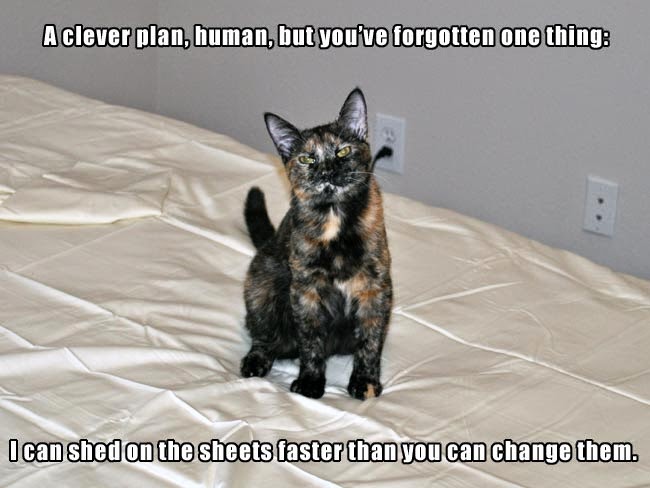
2.  Definitely need a comma here.  "Angry" and "contemptuous" are both observations (we see the naked spite seeping from Shedding-Cat's eyes), which means that these are adjectives from the same category - otherwise known as coordinate adjectives.  You might also notice that it passes the sniff-test mentioned above:  it wouldn't sound weird to say "an angry and contemptuous stare", so we do need to use a comma in the phrase "an angry, contemptuous stare."

(And if you would like an illustrated example of this same idea, look no further than Alexander and the Terrible, Horrible, No Good, Very Bad Day: four adjectives of observation, three commas, and one rotten day.)

3.  Technically, we shouldn't use a comma here. "Hateful" is an observation, and "green-eyed" is a kind of physical description, which means that these two adjectives don't share a category, and so shouldn't have a comma.

"Technically?  Generally?  Usually?  What's with all this weaseling?"


Well, here is the thing, esteemed literarians: you know that "this is America, and we brake for nobody" sentiment we touched on in the beginning?  That same feeling seems to pervade our whole dang language, no matter where you live or which kind of English you speak - and these rules are meant to clarify and organize our speech, not to limit it.

For example, that little chart says that we should put observations before physical descriptions.  But I kind of like the phrase tiny, angry kitty - don't you?  We have a two-two-two syllable count, and each word begins with a stressed syllable and ends with the same Y-sound.  So maybe I want to put things out of order.  And maybe that means we need a comma there, so that we have time to linger and appreciate the symmetry of the words.

Here's another example from my book (she said, ever so shamelessly):

“Oh no, it was a smashing success, textbook really, just brilliant,” Sil hissed up at him, “until YOU stuck your bloody big nose into it! God damn you Elim, what hellborn foolish idiot notion possessed you –”

See that last phrase there?  "Hellborn foolish idiot notion" is DEFINITELY supposed to have commas in there, since every one of those adjectives is from the same "you're an unbelievable dumbass" category (less-colorfully known as the observation category).  But you can see from context that our boy Sil is tearing into Elim with two hands and both barrels: he's swearing at a mile a minute, and I don't want the reader's eyeballs to move any slower than Sil's mouth.  In this case, grammatical correctness has taken a big back seat to the faithful rendering of livid, spit-flecked outrage.

So with adjective order, as with grammar as a whole, what we really have is a two-step process:

1.  Figure out what you're supposed to do (coordinate adjectives, commas, etc.)

2.  Decide whether you want to do that.


"All right, sure.  But if it's all a bunch of hippy-dippy 'do what feels good' granola, why learn the rules at all?"

Why, because if your rule-following successfully communicates to your reader (or wise, benevolent editor) that yes, you really do know what you're doing, he or she is much more likely to let you get away with breaking said rules when it serves your purpose.  Which is why that blistering bastard train-wreck of a sentence above escaped the red pen and went to print last month - and why I would love for you to enjoy the same kind of flexibility and freedom in your own writing!

And since I know I haven't done one of these posts in awhile, a fresh reminder: please send me cats and questions!  Check out the updated photo submissions guidelines (bottom of the post), and hit me up with grammar questions by email or in the comments.  I wanna know what you wanna know!

Further reading:
Adjectival Magnets - a fun adjective-ordering quiz (requires Java)
Commas Between Coordinate Adjectives - also with handy test-yourself quiz at the end
Coordinate Adjectives Versus Cumulative Adjectives

Many thanks to today's GrammatiCats!

1. Bandi, courtesy of Frank the Magnificent
2. Mystery kitten, courtesy of Jarret O.
3. Riki Tiki Tavi, courtesy of M.E. Kinkade (a cracking good author and freelance editor you totally need to know!)
4. Our own free-lovin' Peaches

Thursday, July 4, 2013

GrammatiCats: Pronouns With Comparisons

Hey, guys - and if I haven't said it yet, thanks so much for all your great suggestions for grammar posts.  Let's blow the dust off these kitties and get back to work!

My lovely assistant Willow will now help me select a letter from the mailbag.


...on second thought, let's pull one from the blog comments.

Matt Borgard writes:

"I don't really know the name for this, but proper subject/object usage of a pronoun at the end of a sentence.

'Erika is more tired than [him/he].'"


A terrific question, is it not?  This thorny problem has blown the minds of generations of writers.  (Maybe I shouldn't be amazed, though - Matt's never shied away from the tough stuff.  If you are a fan of sci-fi/fantasy, gaming, and/or the progressive politics of geek fandom at large, his blog is unmissable.  Check him out - and in the meantime, get those pinkies in the upright and locked position.)

Pinkie Rating: 4

Wednesday, June 5, 2013

And the Winner Is...

Okay, random.org has been down for 14 hours now, and I can't stand the suspense anymore.  So, courtesy of randomnumbergenerator.com, we have...


Febe Moss, come on down!  (Email me and let me know where Amazon can find you - soon, all the sentence-structuring secrets of the cosmos will be yours!)

HUGE thanks to all you guys who participated in this humble little project.  This has been hugely helpful and heartening, and I can't wait to start rolling out your awesome ideas. (I was surprised at how many people slipped me wonderful suggestions behind the scenes - maybe next time I should skip the prize and just ask y'all to wring your brains out on command!) 

Also, while we're conjugating "yay" and "huzzah", give a huge one to David Cambron - you know, the guy with all those naked bunnies?  Yeah, he's just signed papers with Inklings Literary Agency, but if you hurry and go right now, you MAY be able to say that you knew him before he was cool.  (This probably means I'll have to quit bullying him in the parking lot at our writers workshop, though.  Dang.)

Lastly, keep your eye on www.dfwcon.org.  Yes, it's the blog for the DFW Writers' Conference, but you don't need to be a local conference-goer to get good mileage out of it: we're going to be running weekly features on broader writing topics, and would really love to have input from writers of all types and stripes.  It's a quality operation.  And I'm not just saying that because they made me the editor.

--Hey, who wants to play Drink the Beer? 
--Right here.
--You win!
--All right, what do I win?
--Another beer!

Tuesday, May 28, 2013

GrammatiCats: Suggest a Topic, Win a Book!

You know, I really didn't intend to go a whole month without a GrammatiCats post.  It just took this long for me and the cats to rest, regroup, and/or make bail.


BUT!  It's almost June, you guys, and high time to get back in the proverbial saddle! Here's the game.

GrammatiCats needs new topics!  And I want to know what YOU want to know.  Do you lie awake at night, agonizing over when to use "that" versus "which"?  Are you wracked with guilt every time you end a sentence with a preposition?  Would your life be utterly complete if only you knew when to use a comma before "if"?

Well, suffer no longer!  Comment on this entry with a grammar/style issue you would like to see covered here, and you could win a copy of June Casagrande's hilarious how-to: It Was the Best of Sentences, It Was the Worst of Sentences: A Writer's Guide to Crafting Killer Sentences.

Here are the rules:

1.  One entry per person. (You can suggest as many topics as you like, but your name will only go in the hat once.)

2.  Contest ends at midnight (Central Standard Time) on Tuesday, June 4th.

3.  The winner will be drawn on Wednesday, June 5th, via random.org, and announced here.

4.  The winner will have 72 hours from announcement to e-mail tex at thetexfiles.com with a valid mailing address.  If the winner doesn't claim the prize, I'll draw and announce a new winner, as in #3 above.

5.  International entries are welcome - if Amazon ships to you, you can enter!

6.  By entering, you certify that you're at least 18 years old, and that sweepstakes are legal in your jurisdiction.

But that is not all, said the Cat in the Hat - no, that is not all!  Even if you don't win the book, you can still get a bona-fide shout-out.  Please include the URL of your blog or social media account in your comment if you'd like me to link back to you.  If I use your suggestion for a future GrammatiCats post, I'll make sure you get the credit!

And as always, cat pics are always welcome: see the GrammatiCats FAQ to find out how your favorite furry friend can be shamed immortalized forever as a champion of literacy!

(Speaking of which: many thanks to today's quasi-GrammatiCat, Éowyn, and her pet human, Dani F.!)

This sentence rocks.

Tuesday, April 30, 2013

GrammatiCats: Zeugma

Zeu-what?

Zeugma.  (Pronounced ZOOGma - the 'eu' is like it is in 'leukemia', and like everybody thinks it is in 'Dr. Seuss'.)

Yeah, I didn't know this one either - but it's totally a thing!  Are you ready for this?  I mean, fair warning:

Pinkie Rating: 5

For real, you guys.  This one isn't long, but it goes deep.

So what's zeugma?  It's like this:


Monday, April 29, 2013

GrammatiCats: Y'all

Well, look.  I was sitting around trying to think of a good grammar topic to do for "Y" today. 

And I said to my cat, I said: "Kitty, what if we did 'your' and 'you're'?"

And she was like,


And I had to admit that it didn't sound like a terribly substantial topic. 

But then I thought, "Wait a minute - we DO know a Y-word that the world needs to understand!  Quickly, kitten - to the Hickmobile!"

Thus, we have arrived at "y'all."  Come!  Let me teach you the pronoun of my people.

Beer Score: 2

Saturday, April 27, 2013

GrammatiCats: XXIV (and Other Roman Numerals)

Yeah, it's a little sneaky, but look: how many grammar words do YOU know that start with "X"?  No jury will convict me!

Actually, though, I'm super jazzed about this post.  I'm a huge Latin / Roman history dweeb, and it came as a surprise to me when I first met someone who couldn't read Roman numerals.

"But didn't you just, you know, want to snort them up your nose and wear them on your face when you were taught them in school?" I asked, perplexed.

Well, apparently not.

But!  Since we do still need them for keeping track of popes, Superbowls and Land Before Time sequels, here for your edification is a no-fear guide to Roman numerals.

Friday, April 26, 2013

GrammatiCats: Was and Were

"Pff, what?  WAS and WERE?  Who doesn't know how to use those?  I 'was' going to read this post, and you 'were' going to write something worth my time.  Handled!"

I know, right?

But then where the dickens do we get "If I were you", and how come Beyoncé's singing about "If I Were A Boy"?  Did Loudon Wainwright screw up in writing "I Wish I Was a Lesbian"?  Should it be "I Wish I WERE a Lesbian," or does it even matter?

These are the burning questions on which our tiny grammatical planetoid turns.  Join us now for a very special episode of "Days of Our Conditional Verb Tenses."

Pinkie Rating: 4

Thursday, April 25, 2013

GrammatiCats: Voice

Hello again from Internet land!

Sorry these last few posts (and comments, visits, et al) have been on the late side - my life's inbox has been full to overflowing with you-know-what.


Anyway, voice!

Not the "finding your unique writing style" kind of voice - that's well outside my purview.  (For that, you need to come to DFWcon and hear Jenny Martin's class: she will take you to the wall!)

But you know how people are always ragging on the "passive voice" and talking about why you shouldn't use it?

Well, I'm here to tell you that - just like alcohol, television, and saturated fats - the passive voice can be part of a healthy literary lifestyle.  And the only way you can make good decisions about when and how much to use it is by having the facts and knowing the alternatives.


... that sounds more like a medical pamphlet than I'd intended, but you get the idea.  Onward, to voice!

Pinkie Rating: 3


Wednesday, April 24, 2013

GrammatiCats: Umlauts

Um-what?

Umlauts!

Otherwise known as "those little dots that Mötley Crüe put in its name for extra metal cred" and "The official  diacritical mark of the Weimar Republic."

"That's great for them," you might say, "but what does that have to do with me?"

Well, have you ever wondered about how or why your word processor autocorrects your writing to say "Noël" or "naïve", or why the New Yorker keeps talking about "preëminence" and "coöperation"?

If so, get your pinkies out, people - we are going to put the ü in über.

Pinkie Rating: 5

Tuesday, April 23, 2013

GrammatiCats: Tmesis

I know, right: you had to click over here just to figure out whether I really did misspell "thesis" that egregiously.

But no!  Check it out, you guys: tmesis is totally a real thing.  Here's one right here:


Did you see it? 

Monday, April 22, 2013

GrammatiCats: Subject and Object Pronouns

All right, you punks - pull up your pants, get off my lawn, and listen up good.  Let me tell you a story.

See, back in the good old days - you know, back when children respected their parents - the linguistic light of the Western world was Latin.  And the cool thing about Latin was that you could arrange the words in your sentence almost any way you wanted, because the ending of each word told you its function. 

For example --

Puer puellam amat.
Puellam amat puer.
Puer amat puellam.

--all mean "The boy loves the girl."  No matter how you arrange the words, the "-am" ending in "puellam" says that the girl is the one who is loved, while "puer" (with no ending) says that the boy is the one who loves.  (If the girl loved the boy, it'd be "Puella puerum amat.")

The same is true for verbs:

Clamo, clamatis, omnes clamamus pro glace lactis.
I scream, you scream, we all scream for ice cream.

Notice how the Latin verb, clamare, changes its ending each time so that you know who's doing the screaming.  You could dump this whole sentence out on the floor, and no matter how you put the words back together, you will ALWAYS know who is doing what to whom.

Two thousand years later, what does the new "international language" called English have to say for itself?


Yeah.  Exactly.  Our words have to hold hands like kindergartners crossing the street, because Lord knows what would happen if we mixed them up.

Before I get you a drink, hit me.
I drink before you get me a hit.
You hit me before I get a drink.

See what I mean?  One jostling of the word order and it's anarchy.

But look just there: we have I and me.  They both mean the same thing, so why are we hardwired to never, ever say Get I a drink or Me hit you?

Could we still retain a glimmer of our noble Latin roots?

Is there anything about this that you don't already know?

Well, I'm throwing down a four-pinkie challenge - let's see how good you are!


Pinkie Rating: 4

Saturday, April 20, 2013

GrammatiCats: Reign and Rein

Just a short one today (tonight?  I'm so hideously far behind!)

I'm not the type to get all bent out of shape when someone comments on a news article and their post has a spelling error.  (For one thing, news article comments are the motel pools of the Internet: swim at your own risk, and whatever you do, don't get any in your mouth.)

However, a depressing number of actual news articles keep messing this up, so I figured it was worth sending the cats out to tackle it.

Because I say things like that now.

Because in my own mind, I'm like Professor X, and my X-Men have names like Adverberus and Modifire and the Predicator.  And I send them out to fight crime, and we all live together in a big secret mansion lair, and I'm never, ever lonely.

What were we talking about?

Right.  Reign and rein.

Pinkie Rating: 3

Friday, April 19, 2013

GrammatiCats: Quotation Marks


I wasn't actually going to do a post about quotation marks.  Because who doesn't know how to use quotes, right?

As it turns out, me.  I was writing the Linking Adverbs post when I realized that I didn't know whether to use single or double quotes when I was referencing a word (such as "however"), and although I sincerely didn't want to have a comma inside the quotes, I wasn't sure whether that was a universal grammatical dictate, or simply an MLA-mandated habit from my school years.

So now we have this post.  By all means, help me to remediate myself!

N.B.:  All of the following advice concerns American usage.  Quotation practices are considerably different in other English-speaking parts of the world.


Pinkie Rating: 3

First of all, I'm going into this with the assumption that you guys are already pretty good with the ol' double quotes.

1.  Dialogue and Other Direct Quotations


Wednesday, April 17, 2013

GrammatiCats: Or and Nor

Y'know, I seriously considered slapping a couple of extra I's in the title so this could be a post about dwarves.

But no!  The GrammatiCats remain ever committed to their purpose, and will not yield to temptation.


Okay, they might occasionally yield to temptation.

Likewise, you might occasionally think to yourself, "man, I have a judo-grip on this grammar thing.  I am a super-literate sentence-making demigod, and nothing you say about or and nor could possibly be news to me."

Well, batten your hatches and buckle your swash, because today marks GrammatiCats' first-ever...

Pinkie Rating: 5

...FULL-FRONTAL FIVE-PINKIE FREE-FOR-ALL.

Dare you enter this cave of conjunctive wonders?

Monday, April 15, 2013

GrammatiCats: Mondegreens and Eggcorns

Yeah, you thought this was going to be Misplaced Modifiers, didn't you?

Okay, well, maybe you didn't.  I did.  I was like, "but maybe I should do mass nouns and count nouns!"  "But misplaced modifiers are more important!"  "But that's what every other grammar-blog's gonna do!"  "But - "


And that's how we got here. 

So what's a mondegreen?
Pinkie Rating: 2

Saturday, April 13, 2013

GrammatiCats: Linking Adverbs

Ugh.

I'm loving these posts, y'all, but I'm hating these post titles.  Linking adverbs.  That sounds about as fun and zesty as corrugated brochure holders or lukewarm soy paste.  If linking adverbs were a cereal, the first three ingredients would be oat bran, unbleached unbromated wheat flour, and boredom.

I'm convinced that this is why we don't pick this stuff up in school, either.  The teacher's all


and the students are all


and not a single damn is given.

However!

I have something to tell you (about the word "however," in fact) which I believe will be relevant and useful to your writing. I will endeavor to make it succinct, interesting, and thoroughly kittylicious.

Venture forth with me, then, as we journey deep into the darkest heart of Conjunctive Adverbia.

Pinkie Rating: 4

Friday, April 12, 2013

GrammatiCats: Kicking the Bucket (and Other Idioms)

Do you know what?  It's freakin' FRIDAY, y'all.  And that last post was a humdinger.

So!  Let's kick back and play a game.  How many of these expressions do you know?

1.  To scare off the mule

2.  To stretch out the legs

3.  To look at a radish from underneath

4.  To become a Buddha

5.  To eat dandelions by the root

Click for answers:

Thursday, April 11, 2013

GrammatiCats: Joining Sentences

You know, I'm not a huge expert when it comes to the finer points of social interaction. 

It's not that I don't enjoy meeting new folks.  It's just that when you spend most of your time nose-bagging Cheetos, molesting your word processor, and scratching yourself, it's sometimes hard to know how to take the people who wander into your life.  Do you want to be friends with me?  Are you just being nice because you have to?  Do you actually really want to do coffee sometime, or does this number you just gave me belong to a laundromat out in Cleburne?

I think ideas can be just as tricky to connect as people.  It's not that we don't know how to use a semicolon or trade business cards, but sometimes it's hard to intuit when to do what in order to make the right kind of connection. 

So that's what I'd like to look at today: a few ways to join up sentences, with an emphasis on where they each tend to be most effective.  Think of it as Match.com for your ideas!


Pinkie Rating: 3